Investigation · Part 3 · Human rights
Watched at home, barred at the border: the fear Nicaraguans and Americans live with under Ortega
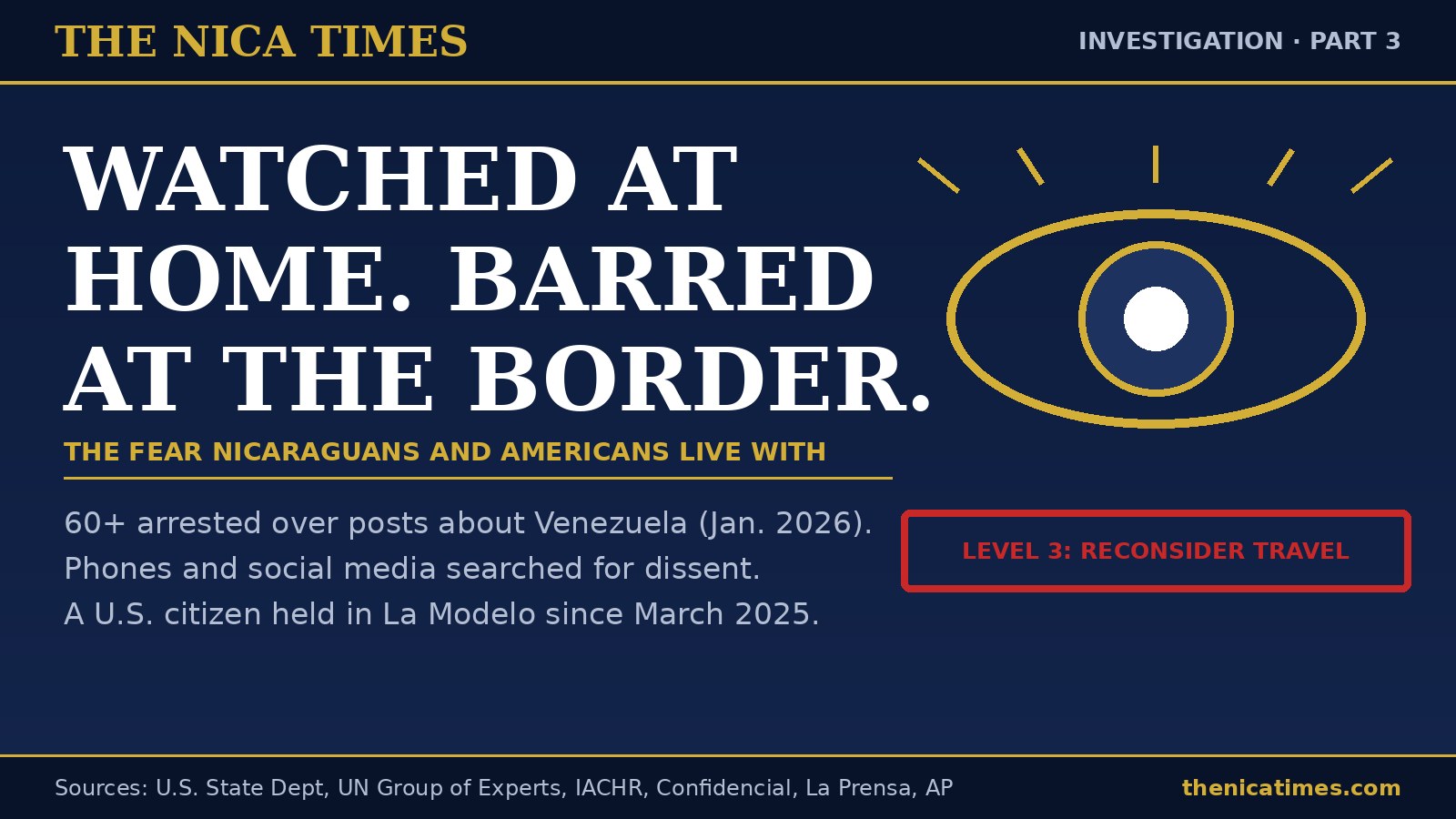
Neighborhood surveillance posts. Arrests over Facebook comments. Phones searched at the airport. Citizenship stripped. A U.S. citizen held in solitary confinement for 19 months. The public record shows a system built to make people afraid, and Americans are not exempt.
Part 3 of our investigations series. Part 1: Seven years later, no one charged in the prison killing of U.S. Navy veteran Eddy Montes. Part 2: Police said they solved an American’s killing in 48 hours. One suspect was in a coma.
Twelve hours after U.S. forces captured Venezuela’s Nicolás Maduro, Rosario Murillo met Sandinista cadres, Army and Police officials at El Carmen on Jan. 3, 2026. According to sources linked to the FSLN Secretariat, she ordered party structures into a “state of alert,” told them to monitor comments on social media and to set up “revolutionary surveillance command posts” in neighborhoods so that anyone who “threatens peace” could be “detained immediately” (Confidencial).
Within a week, at least 60 Nicaraguans had been taken by police in at least eight departments, most for celebrating Maduro’s fall or commenting online (Confidencial/Monitoreo Azul y Blanco). The Inter-American Commission on Human Rights said it had information on the detention of “more than sixty people for expressing opinions on social media” (IACHR).
What we know
- The U.S. rates Nicaragua Level 3, “Reconsider travel,” citing wrongful detention and arbitrary enforcement of laws (May 14, 2026).
- Washington says officials may search phones, computers and social media for anti-government content.
- UN experts documented a state surveillance network using informants, at home and abroad.
- 60+ people were detained in January 2026 over social media posts about Venezuela.
- Since Jan. 16, 2026, Nicaragua’s constitution bans dual nationality; some dual U.S. citizens lost Nicaraguan citizenship.
- U.S. citizen Alain Piedra Hernández has been held since March 15, 2025, reportedly incommunicado.
What we don’t know
- How many informants work in the neighborhood networks.
- How many Americans have been denied entry or barred from leaving; no official count is public.
- What charge, if any, Piedra faces. La Prensa found none in the court system.
- How many of the January detainees remain in custody.
- How many U.S. citizens currently live in Nicaragua.
A machine for watching
In September 2025 the UN Group of Human Rights Experts on Nicaragua reported a “wide and complex surveillance and intelligence network” of government institutions and the ruling FSLN party, answering to the co-presidents. It is used, the experts wrote, to “monitor the population’s activities, both physically and online,” and to “decide who should be arrested, expelled, prevented from returning or stripped of their nationality” (UN Group of Experts, “Persecution Beyond Borders”).
The experts said the network is coordinated by the Army’s Defence Intelligence Directorate, with the police and foreign service, and that “undercover officials and informants” surveil targets and report on their movements and associations (Reuters). It reaches exiles abroad through social-media monitoring, account hacking and threats.
The price of a post can be exile. In April 2023, police in Río San Juan jailed a 17-year-old for a few hours over a Facebook post remembering those killed in 2018, then released him to his mother on condition that he leave and “not return to Nicaragua” (Confidencial).
Families as leverage
The regime has gone after relatives of critics who are out of reach. La Prensa reported in February 2025 that threats against family members had become a new phase of repression aimed at silencing exiles (La Prensa). Confidencial documented relatives of “wanted” opponents held in jail (Confidencial). The UN experts found arrests, surveillance, threats, confiscations and passport denials against relatives “solely” for their family ties, and said this drove exiles to self-censor (UN Group of Experts).
Those released are not free. When the regime let some political prisoners go home in January 2026, the IACHR noted they must report regularly to police, remain under surveillance and are restricted from meetings, religious activities and speaking on social media (IACHR).
Americans are targets too
The State Department’s advisory, reissued May 14, 2026, says U.S. nationals are “at serious risk of wrongful detention” and may be held “for years, in poor conditions, and without due process.” It warns that Americans “may be denied entry or prevented from leaving Nicaragua without explanation,” that the government has imposed exit bans on U.S. citizens, and that it has targeted missionaries, teachers, NGO workers, business people, journalists and current and former U.S. government employees (U.S. State Department). It also says immigration authorities “regularly review social media” for political expression, and it advises travelers to delete sensitive content from their devices before going.
In August 2025, the State Department added Nicaragua to the short list of countries flagged with a “D” indicator for wrongful detention risk, alongside Iran, North Korea and Russia (La Prensa).
One American is in that situation now. Alain Piedra Hernández, 53, a naturalized U.S. citizen and coffee businessman, was detained on March 15, 2025. The IACHR says he is reportedly held in La Modelo prison, in solitary confinement in a punishment cell, without contact with his family in the United States; it granted him precautionary measures on May 24, 2026 (IACHR). La Prensa found no criminal charge against him in the judiciary’s online system (La Prensa). On Sept. 9, 2026, the IACHR asked the Inter-American Court to extend protective measures to him (CIDH).
Mountain Gateway, a Texas-based ministry, saw its Nicaraguan pastors jailed; they were among 135 prisoners freed to Guatemala in September 2024 after U.S. negotiations (AP). La Prensa reports its American founder and his family remain under investigation in Nicaragua (La Prensa).
Stripped of country
In February 2023, Nicaragua put 222 political prisoners on a plane to Washington and then voted to strip them of citizenship (AP). One of them, business leader Michael Healy, was a dual U.S.-Nicaraguan citizen; his property was confiscated and his nationality revoked (La Prensa). On Jan. 16, 2026, the regime amended the constitution to prohibit dual nationality, and the State Department says some dual Nicaraguan-U.S. citizens have since had their Nicaraguan citizenship revoked (U.S. State Department).
Timeline
- Feb. 9, 2023222 political prisoners expelled to the U.S. and stripped of citizenship (AP).
- April 19, 2023A teenager is jailed over a Facebook post and banished (Confidencial).
- Sept. 2024135 prisoners, including Mountain Gateway pastors, freed to Guatemala (AP).
- March 15, 2025U.S. citizen Alain Piedra Hernández detained (IACHR).
- Aug. 18, 2025State Dept flags Nicaragua with its “D” wrongful-detention indicator (La Prensa).
- Sept. 23, 2025UN experts publish “Persecution Beyond Borders” (OHCHR).
- Jan. 3, 2026Murillo orders neighborhood and social media surveillance (Confidencial).
- Jan. 9, 2026At least 60 detained over Venezuela posts (Confidencial).
- Jan. 16, 2026Constitution bans dual nationality (State Dept).
- May 14, 2026U.S. travel advisory reissued at Level 3 (State Dept).
- May 24, 2026IACHR grants Piedra precautionary measures (IACHR).
- Sept. 9, 2026IACHR asks the Inter-American Court to protect Piedra (CIDH).
The U.S. angle
The U.S. Embassy in Managua said in January that “more than 60 people” remained “unjustly detained or disappeared” in Nicaragua (Tico Times/AFP). Washington’s own advisory tells Americans the best way to avoid wrongful detention is not to go. Yet a U.S. citizen has sat in La Modelo for 19 months with no public charge, and no public statement from the State Department on his case was found in our review.
Why it matters: The same surveillance system that jails Nicaraguans for a Facebook comment screens Americans at the airport, and the U.S. government says it cannot guarantee their release.
Have you or your family been watched, threatened or barred?
Send us a tip: [email protected]. We protect our sources.
Read the series: Part 1, Eddy Montes · Part 2, Sixto Henry Vera · Part 3, this story.